

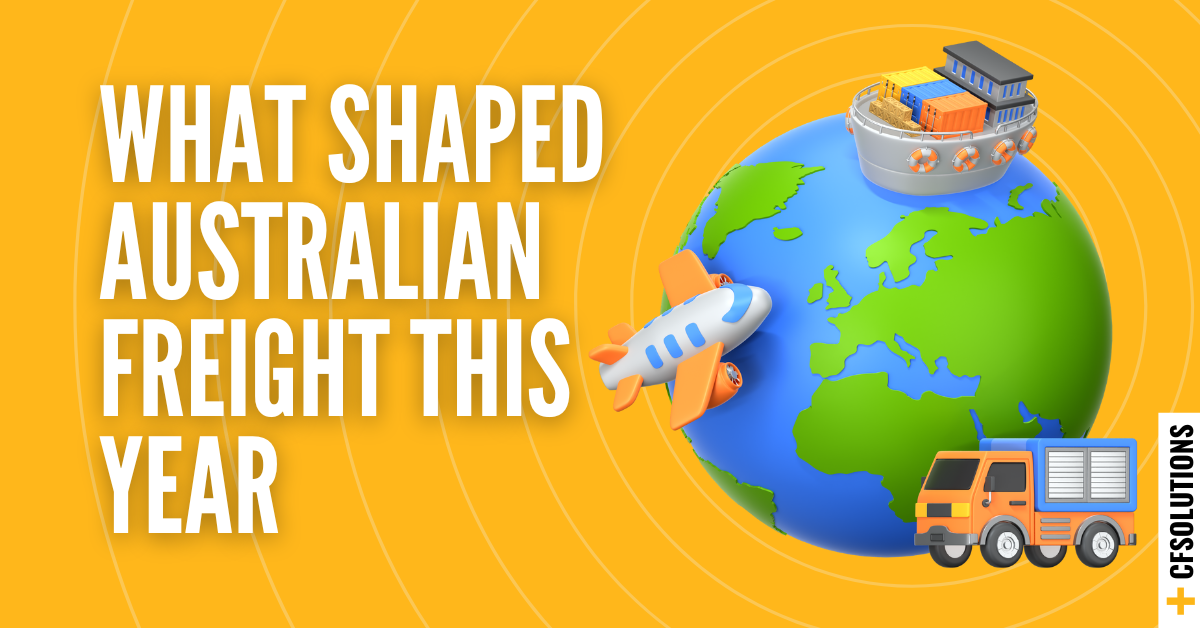
The past twelve months have continued to reshape how Australian businesses move freight. While national volumes have remained steady, 2025 has been defined by smarter planning, stronger carrier partnerships, and an increased reliance on technology to maintain reliability and transparency.
At Customised Freight Solutions, we have seen firsthand how these shifts have influenced performance across our client base. From tighter linehaul capacity to more consistent air freight utilisation, the industry is clearly moving toward data-led and relationship-driven logistics.
Here are some of the defining trends that stood out this year.
1. Air Freight Became an Operational Advantage
Domestic air freight remained one of the strongest performers in 2025. Capacity across major corridors such as Sydney to Melbourne, Brisbane to Adelaide and Perth to East Coast routes stayed stable, while demand from healthcare, manufacturing and retail sectors increased.
We saw more businesses using air freight not only for urgent freight but as part of their regular mix to reduce downtime, maintain service standards and offset road congestion. Same-day and next-flight services proved particularly valuable for clients managing production continuity or retail commitments.
The lesson is clear: air freight is no longer a backup plan. It has become an essential part of a balanced domestic freight strategy.
2. Network Planning and Collaboration Defined Cost Stability
Freight pricing in 2025 was shaped more by planning than by market fluctuation. Businesses that shared forecasts and confirmed allocations early saw far fewer rate changes compared to those booking reactively.
Across the industry, proactive collaboration with carriers became one of the best ways to control costs and maintain service reliability. When carriers can plan ahead, they manage resources more efficiently and reward consistency with stable pricing.
This approach also allowed businesses to access preferred transit schedules and reduce the impact of short-term fuel or levy adjustments later in the year.
3. Visibility Became a Business Expectation
In 2025, visibility was no longer a nice-to-have. Customers expected live updates, accurate ETAs and proactive communication. Businesses that invested in transport management systems and live tracking technology were able to deliver that transparency, not just to clients but internally across their teams.
We noticed that data accuracy became one of the strongest indicators of freight performance. Clean data meant faster invoicing, fewer disputes and better reporting for management and forecasting.
4. Freight Teams Prioritised Partnership Over Price
Another defining shift this year was mindset. Businesses increasingly valued long-term relationships with freight partners who could provide consistency, support and advice, not just competitive rates.
At CFS, we found that collaboration between clients, carriers and our internal teams led to faster issue resolution, clearer communication and stronger results during high-volume periods. Partnership proved to be one of the most effective risk management tools in freight.
5. 2026 Will Focus on Efficiency and Resilience
The year ahead is likely to focus on three areas: efficiency, resilience and sustainable operation.
-
Efficiency through improved automation and process visibility.
-
Resilience through diversified carrier networks and stronger forecasting.
-
Sustainability through reduced empty kilometres, accurate routing and carbon reporting.
January is the ideal time to review how your business performed this year. Look at service data, on-time performance and cost-to-serve. Small adjustments in the first quarter can create significant savings and operational improvements by mid-year.
2025 has reinforced that freight performance is about precision, not just movement. Businesses that embrace data, planning and partnership will continue to find the balance between service reliability and cost control.
Talk to us about reviewing your freight operations and planning smarter for 2026.
Related Posts
.png)
Sep 8 2026
The Hidden Cost of Freight Administration
The true cost of freight extends well beyond the line item on a ...
Read More
Jul 6 2026
Freight Reviews in Practice: What to Assess and Why It Matters
Freight reviews are often discussed, but not always structured. Many ...
Read More
May 11 2026
Designing a Freight Network That Scales
Growth is a positive challenge for any business. Increased volume, ...
Read More